
What does the TV Academy Think About AI? | With Christina Lee Storm
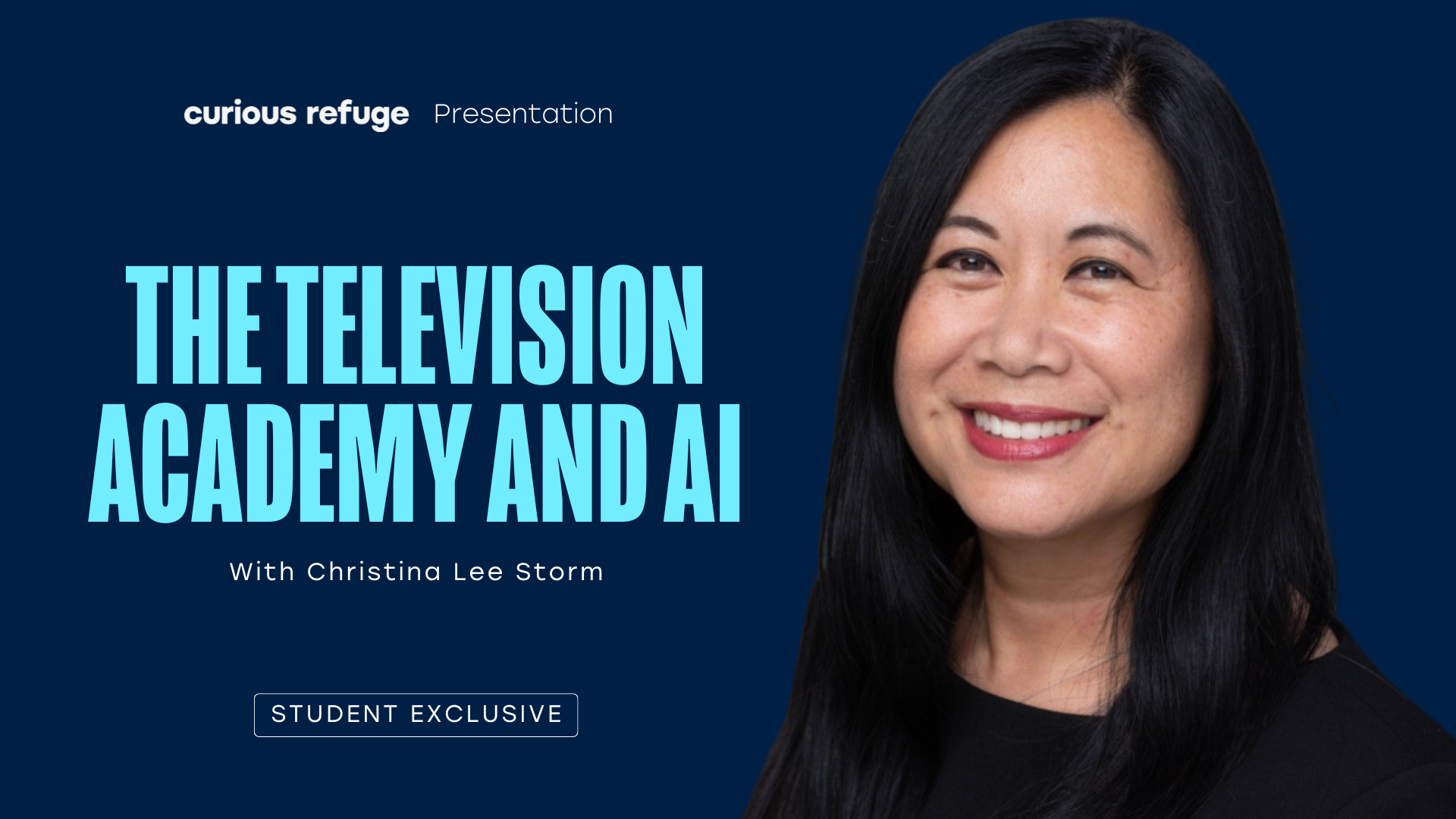
In this article, we sat down with Christina Lee Storm to hear how the TV Academy is thinking about Artificial intelligence.
Generative AI is changing more than just creative tools; it’s reshaping the careers and livelihoods of tens of thousands of people across the entertainment industry.
In today’s interview, we sit down with Christina Lee Storm, a leading voice in generative AI and emerging technology within Hollywood.
Christina is a Governor for the Emerging Media Programming peer group at the Television Academy and leads the Working Group for Responsible AI and Production Standards.
She has worked across Netflix, DreamWorks, USC’s Entertainment Technology Center, and several AI studios, and brings a rare perspective that bridges creativity, technology, and industry policy.
In this conversation, we discuss how the Television Academy is thinking about generative AI, the recently released Key Considerations document, and what all of this means for real-world production workflows.
What does the TV Academy Think About AI?
Below is the full video interview with Christina Lee Storm. Enjoy!
What does the TV Academy Think About AI? | With Christina Lee Storm
Below are a few questions from an interview with Christina Lee Storm. To access the full interview, check your student portal.
How is the Television Academy thinking about generative AI right now?
There’s a lot of tension around generative AI. Some people are very hesitant, while others are leaning all the way in. What we’ve found is that education is the starting point. Before people decide whether to use these tools, they need to understand them.
At the Television Academy, we represent nearly 30,000 members across 31 peer groups. Many of those members are professionals actively producing content. We felt a responsibility to help them learn what these tools are, what they do, and how they might impact production — without forcing adoption.
We have a mandate that it’s imperative to learn the tools, not imperative to use them.
What led to the creation of the “Key Considerations” document?
In the spring, I sensed a growing divide. There was a lot of fear, confusion, and mixed messaging coming from headlines, legislation, and social media. We needed something proactive, a way to give members guidance without prescribing rigid rules.
The goal was to create a framework that helps professionals ask the right questions when generative AI shows up on a project. Not to boil the ocean, but to start meaningful conversations.
At the same time, similar efforts were happening at the Producers Guild and at studios like Netflix. It felt like the right moment to contribute something from the Television Academy’s perspective.
You can download the document to review here.
What are the core principles behind the Key Considerations?
The framework is built around three main principles:
Creative integrity — respecting creators, performers, and craftspeople
Permissions and licensing — ensuring legal and commercial viability
Accountability, transparency, and sustainability
These considerations are meant to help professionals evaluate what is possible, what is ethical, and what is sustainable long-term.
Why is creative integrity such an important starting point?
The Television Academy represents professionals. There’s an expectation of excellence, inclusion, and integrity in the work. The first question is meant to ground everything in that idea.
It’s easy to be tempted to use AI purely to cut costs. But the real question should be whether it supports human authorship and strengthens the creative vision, rather than undermining it.
Can generative AI support strong creative intent, or does it dilute it?
I think it can do both, depending on how it’s used. Historically, production workflows were very rigid — storyboards, shot lists, and exact execution. Generative AI introduces a more improvisational element.
That doesn’t mean losing control of the vision. It means there may be multiple pathways to get there. Similar to independent filmmaking, where limitations force creativity, AI can open new creative routes while still honoring intent.
How do you think about generative AI in relation to budgets?
If the main question is “How cheap can we make this?” — that’s the wrong question.
Yes, there may be efficiencies. But the real opportunity is using AI to expand creative output, deepen world-building, and reach audiences across platforms. Instead of shrinking budgets vertically, you can expand horizontally — more content, more engagement, more longevity.
Focusing only on cost-cutting risks breaking the creative ecosystem entirely.
What lessons from the VFX industry influence your thinking here?
I worked at Rhythm & Hues when the company went bankrupt while winning an Oscar for Life of Pi. That experience deeply shaped me.
When industries race to the bottom on cost, artists suffer, sustainability collapses, and the entire ecosystem weakens. I don’t want to see storytelling go down that same path.
Technology should help industries survive and thrive, not hollow them out.
Once the novelty of AI wears off, what actually matters?
Story always wins.
The spectacle fades quickly. What remains is character, meaning, and emotional resonance. Generative AI can help create worlds and visuals, but storytelling fundamentals don’t change.
If anything, these tools push creators to level up their storytelling skills.
What role does audience interaction play in emerging media?
We’ve seen fascinating projects where audiences vote or influence outcomes, especially in emerging media and interactive storytelling.
What people really want is shared experience — something they can talk about, react to together, and remember. Even with interactivity, there still needs to be a canonical story and intentional design behind it.
What are the biggest barriers to AI adoption in professional workflows?
It comes down to three pillars of the entertainment industry:
Clear chain of title (copyright)
Payment for services
Residuals
There are still unresolved legal questions around training data and ownership. Professionals need clarity before they can fully adopt these tools responsibly.
Adoption is slower because the stakes are higher.
How should producers rethink budgets for AI-assisted workflows?
Budgets need to be viewed holistically. VFX or AI is rarely the largest line item, yet it often gets the most scrutiny.
Rather than forcing AI into old budget structures, producers should rethink how projects are designed from the start — where AI makes sense, where traditional production makes sense, and how everything works together.
How do you personally stay up to date on AI and emerging tech?
I follow AI news closely through Curious Refuge, industry conversations, and our Substack The Creative & Tech Orbit, which I co-write with Carolyn Giardina.
The goal is to go beyond headlines and provide real analysis and insight into what’s actually happening.
You can also find me on Instagram and LinkedIn.
Where do I see more interviews like this?
This conversation with Christina Lee Storm highlights an important truth: generative AI isn’t just a creative tool; it’s an industry-shaping force that demands thoughtful, responsible leadership.
If you enjoyed this interview and are interested in more just like this, check out your student portal, where we are offering everything from weekly office hours to interviews with professionals like Christina, and even hands-on instruction from world-class artists.
Make sure to fill out the form above to stay up to date on the upcoming interviews and office hours!
